If you’ve been wondering why you feel anxious at night for no apparent reason, you’re not alone. You may go through your day feeling relatively fine and then notice racing thoughts, a pounding heart, restlessness, or a sudden sense that something is wrong when you get into bed.
Nighttime anxiety can have several possible causes. Stress, repetitive worry, poor sleep, caffeine, anxiety disorders, medications, and some medical or sleep conditions can all play a role. Sleep and anxiety can also affect each other: anxiety can make sleep harder, while insufficient or disrupted sleep can increase anxiety. [1][2]
If nighttime anxiety happens occasionally, it does not necessarily mean that something is seriously wrong. But if it is frequent, severe, or repeatedly interferes with your sleep or daily life, it is worth discussing with a healthcare professional.
Table of Contents
Why Does Anxiety Sometimes Feel Worse at Night?
Nighttime can feel different from daytime because many of the distractions that occupy your attention disappear.
Work, school, conversations, errands, and other activities can keep your mind focused during the day. When everything becomes quiet, worries that were pushed aside may become much more noticeable.
There may also be a biological component. Research suggests that sleep loss and being awake during the biological night can affect emotional regulation, cognitive control, and anxiety-related brain processes. [1][3]
That does not mean your brain suddenly becomes unhealthy after dark. Rather, sleep pressure, circadian rhythms, stress, and fewer distractions can combine to make existing worries feel more intense.
9 Possible Reasons You Feel Anxious at Night
1. You Finally Have Time to Think
During the day, there may be little time to process everything that is bothering you.
At night, however, your surroundings become quieter. Without the usual distractions, unfinished problems and worries can move into the foreground.
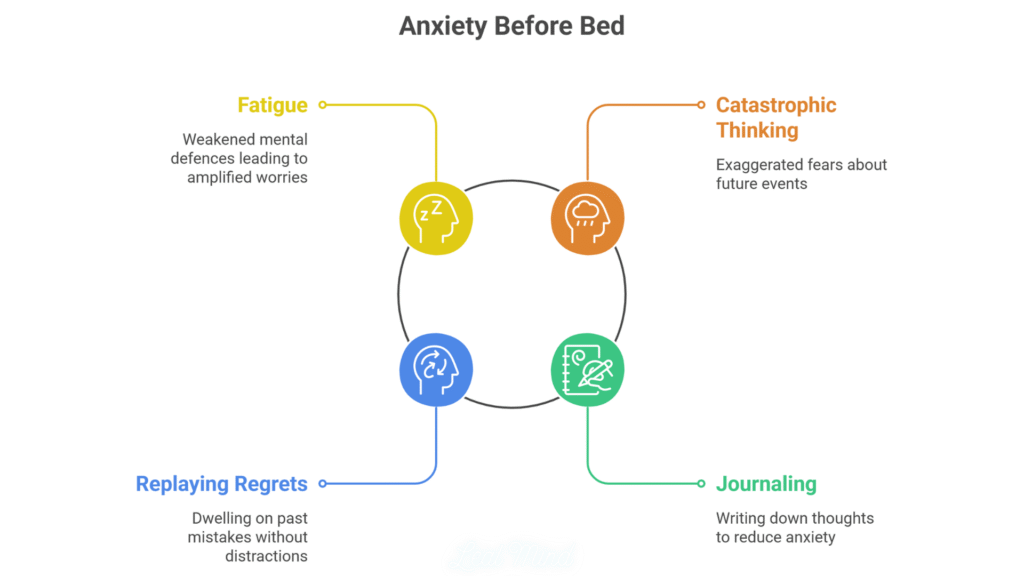
You might start replaying conversations, thinking about tomorrow, or imagining what could go wrong.
Research suggests that worry and other sleep-related thought processes can contribute to insomnia and may become part of a cycle in which anxiety and poor sleep reinforce each other. [2]
Try this: Before bed, write down what is worrying you and, if possible, one small action you can take the next day. The goal is not to solve everything at night. It is simply to give your thoughts somewhere to go.
2. Poor or Insufficient Sleep May Be Increasing Your Anxiety
Sleep and anxiety have a two-way relationship.
Anxiety can make it harder to fall asleep or stay asleep. At the same time, sleep deprivation can increase anxiety and emotional reactivity. Research has found substantial sleep disturbance among people with anxiety-related disorders, and experimental research shows that sleep loss can increase anxiety. [1][4]
This can create a cycle:
Anxiety → poorer sleep → greater vulnerability to anxiety → more difficulty sleeping.
If you regularly get too little sleep, improving your sleep habits may be an important part of addressing nighttime anxiety.
3. Your Circadian Rhythm May Affect How You Feel at Night
Your circadian rhythm is your body’s roughly 24-hour timing system. It helps regulate sleep and wakefulness and interacts with other biological processes.
When you remain awake during the biological night, sleep pressure and circadian influences can affect mood, attention, and emotional regulation. Research on nighttime wakefulness suggests that these effects can make negative thoughts and emotional reactions feel stronger. [3]
This may help explain why a problem that seems manageable during the afternoon can feel much more overwhelming in the middle of the night.
Your nighttime perspective is real, but it may not always be the best time to make major decisions about a difficult situation.
4. You May Be Caught in a Cycle of Worry
Sometimes nighttime anxiety is driven less by one particular problem and more by repetitive thinking.
You may find yourself asking:
- What if something goes wrong tomorrow?
- Why can’t I fall asleep?
- What if I never feel better?
- Did I make a mistake today?
- What if something is wrong with me?
Trying to force every anxious thought away can sometimes keep your attention focused on the anxiety itself.
Try this: Notice the thought without automatically treating it as a fact.
For example:
“I’m having a worry about tomorrow.”
Then gently return your attention to your breathing, your surroundings, or another neutral activity.
5. Caffeine May Still Be Affecting You
Caffeine can remain active for several hours and may interfere with sleep when consumed later in the day.
In a randomized controlled study, a 400-mg dose of caffeine significantly disrupted sleep even when it was consumed six hours before bedtime. The study used a relatively high dose, however, so the finding should not be interpreted as meaning that everyone will respond identically. Individual sensitivity varies. [5]
If you experience nighttime anxiety or difficulty sleeping, consider tracking when you consume coffee, tea, energy drinks, cola, pre-workout products, or other sources of caffeine.
Reducing caffeine later in the day may help if you are sensitive to its effects.
6. Alcohol, Medications, or Other Substances May Be Affecting Sleep
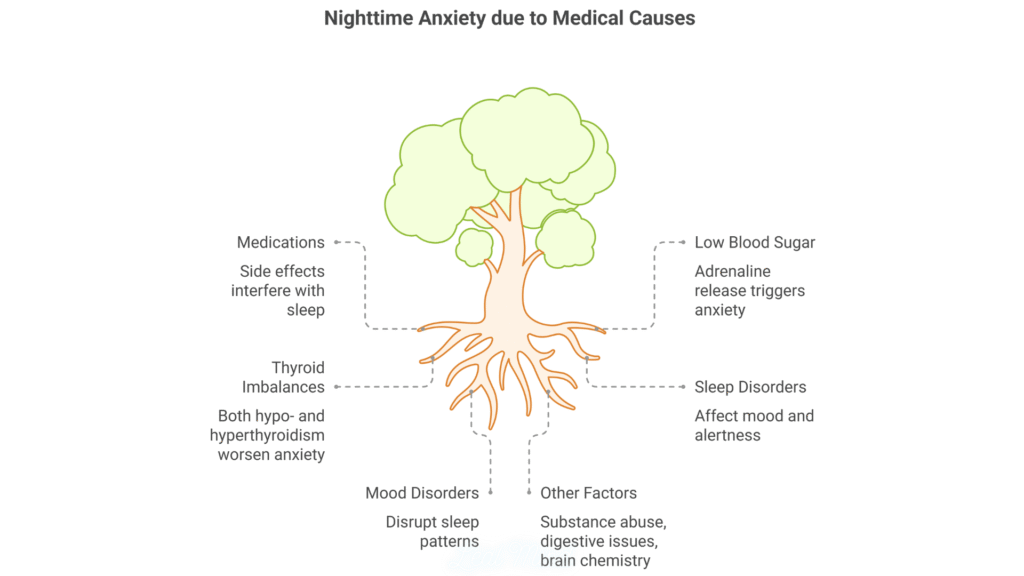
Alcohol can make some people feel sleepy initially, but it can also interfere with sleep as the night progresses.
Certain medications and other substances can also affect sleep or levels of alertness. The effect depends on the specific medication, dose, timing, and individual.
If you suspect that a prescribed medication is contributing to nighttime symptoms, do not stop taking it on your own. Discuss your concerns with your doctor, pharmacist, or another qualified healthcare professional.
7. An Anxiety Disorder or Panic Attacks May Be Involved
Nighttime anxiety can sometimes occur as part of a broader anxiety problem.
People with panic disorder can experience nocturnal panic attacks, in which they wake from sleep in a state of intense fear or panic. A review of the research found that 44–71% of people with panic disorder reported experiencing at least one nocturnal panic attack. [6]
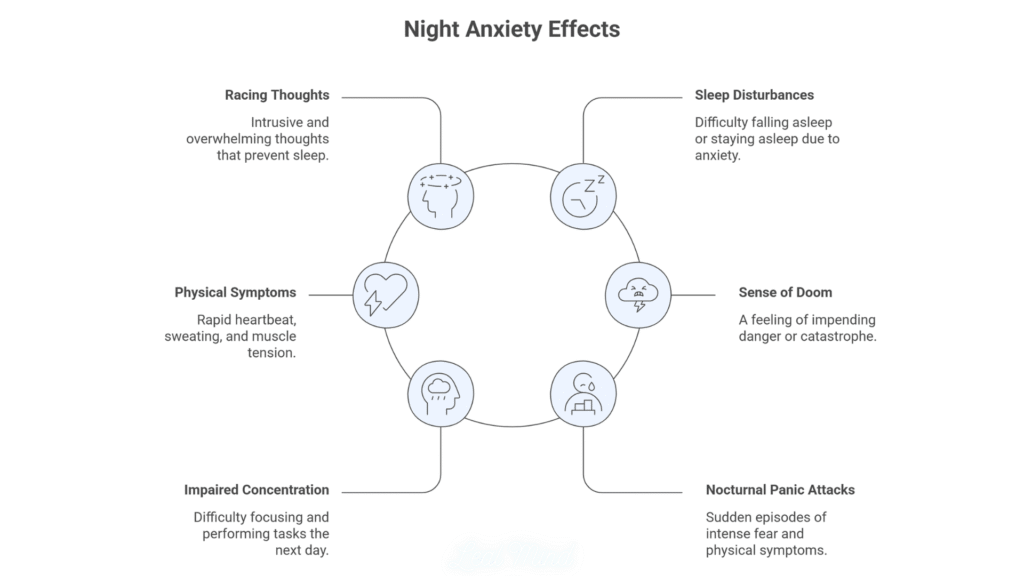
A nocturnal panic attack can involve:
- sudden intense fear
- a racing or pounding heartbeat
- sweating
- trembling
- shortness of breath
- chest discomfort
- dizziness
- a feeling of losing control
Not every nighttime episode of anxiety is a panic attack. If these episodes happen repeatedly or are particularly frightening, consider discussing them with a qualified healthcare professional.
8. A Medical or Sleep Condition Could Be Contributing
Sometimes symptoms that feel like anxiety can have a physical or sleep-related contributor.
For example, hyperthyroidism can cause nervousness, irritability, trouble sleeping, fatigue, sweating, and a rapid or irregular heartbeat. [7]
Sleep apnea can involve breathing that repeatedly stops and starts during sleep, loud snoring, gasping for air, insomnia, and daytime sleepiness or fatigue. [8]
This does not mean that nighttime anxiety is usually caused by a medical condition. It means that persistent or unexplained symptoms should not automatically be assumed to be psychological.
Talk with a healthcare professional if you regularly wake gasping for air, have significant daytime sleepiness, experience persistent palpitations, or have other concerning physical symptoms.
9. Stress May Be Catching Up With You at Night
You may spend the day functioning normally while dealing with considerable stress from work, school, relationships, finances, health concerns, or other responsibilities.
When the day becomes quiet, you may become more aware of how tense or overwhelmed you have been feeling.
This can make nighttime anxiety appear to come “out of nowhere,” even though stress has been building throughout the day.
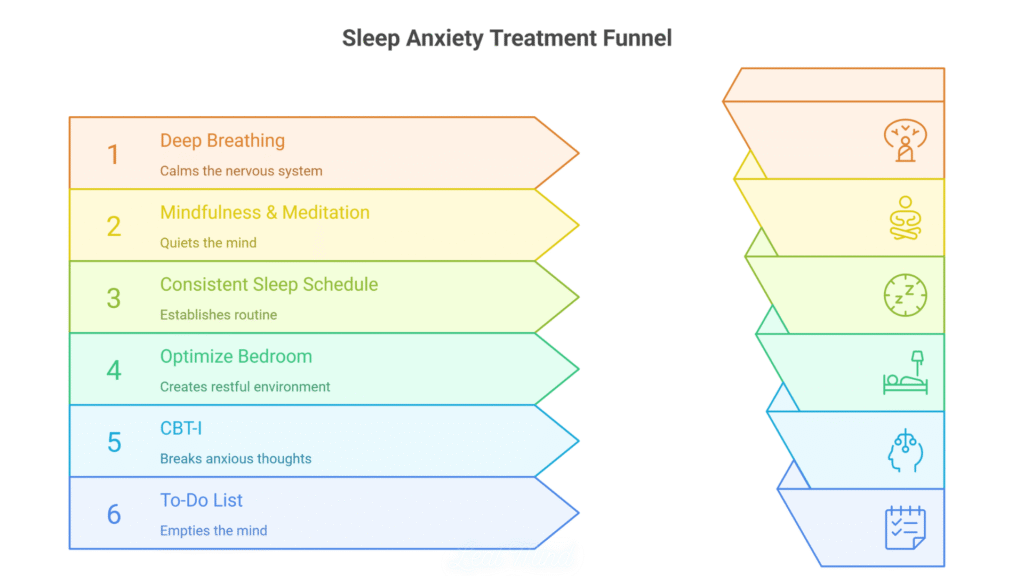
What Can You Do When You Feel Anxious at Night?
You do not need to solve every problem before going to sleep.
Instead, focus on creating conditions that make it easier for your body and mind to settle.
1. Write Down Your Worries
If a particular concern keeps returning, write it down.
If there is something you can realistically do tomorrow, write down the next step.
Then remind yourself:
“I don’t have to solve this tonight.”
2. Create a Calmer Transition to Bed
Give yourself some time to move from daytime activity toward sleep.
You might:
- dim the lights
- put away stimulating work
- reduce late-night scrolling
- read something calming
- listen to quiet music
- take a warm shower
- practice slow breathing
- use a relaxing bedtime routine
The aim is not to create a perfect routine. It is to make the transition into sleep more predictable.
3. Watch Your Caffeine Timing
If nighttime anxiety or difficulty sleeping is a recurring problem, consider reducing caffeine later in the day.
Remember that the controlled caffeine study used 400 mg, so your personal response may differ. [5]
4. Don’t Treat Every Anxious Thought as a Fact
When an anxious thought appears, try noticing it rather than immediately responding to it.
For example:
“I’m noticing the thought that something bad might happen.”
You can then return your attention to your breathing or another neutral sensation.
5. Keep Your Sleep Schedule Reasonably Consistent
Going to bed and waking at roughly consistent times can help support a regular sleep-wake schedule.
However, if you have persistent insomnia, basic sleep-hygiene advice may not be enough. Current clinical guidance recommends cognitive behavioral therapy for insomnia (CBT-I) as an evidence-based treatment for chronic insomnia. [9]
CBT-I is a structured treatment that addresses the thoughts and behaviors that can maintain insomnia.
6. Consider Professional Help
Consider speaking with a healthcare or mental-health professional if nighttime anxiety:
- happens frequently
- repeatedly wakes you from sleep
- significantly affects your daytime functioning
- causes you to fear going to bed
- involves repeated panic attacks
- continues despite changes to your sleep routine
- occurs alongside concerning physical symptoms
A professional can help determine whether anxiety, insomnia, panic attacks, medication effects, or another health condition may be contributing.
When Should Nighttime Anxiety Be Taken Seriously?
Occasional anxiety at night does not necessarily mean that you have an anxiety disorder.
However, persistent or severe symptoms deserve attention.
Seek urgent medical care if anxiety-like symptoms occur with severe or unexplained chest pain, serious difficulty breathing, fainting, or other symptoms that could indicate a medical emergency.
If you are experiencing thoughts of suicide or harming yourself, seek immediate help from local emergency services, a crisis service, or a trusted person who can help you stay safe.
Frequently Asked Questions
Why do I get anxiety at night?
Nighttime anxiety can have several possible causes, including stress, repetitive worry, poor sleep, caffeine, alcohol, panic attacks, anxiety disorders, medications, and some medical or sleep conditions.
Sometimes there is no single identifiable cause.
Why is anxiety worse at night but better during the day?
Daytime activities can keep your attention occupied and leave less time for repetitive thinking. At night, fewer distractions may make worries more noticeable. Sleep pressure and circadian influences may also affect emotional regulation during nighttime wakefulness. [1][3]
Can lack of sleep cause anxiety?
Yes. Sleep loss can increase anxiety, while anxiety can also interfere with sleep. This can create a cycle in which poor sleep and anxiety reinforce each other. [1][4]
Can caffeine cause nighttime anxiety?
Caffeine can increase alertness and interfere with sleep, particularly when consumed later in the day. One controlled study found significant sleep disruption after 400 mg of caffeine taken six hours before bedtime. Individual sensitivity varies. [5]
Should I worry if I wake up with a racing heart?
A racing heart can occur during anxiety or panic, but it can also have other causes. If it happens repeatedly, is severe, or occurs with chest pain, fainting, significant shortness of breath, or other concerning symptoms, seek medical evaluation.
What is sleep anxiety?
Sleep anxiety refers to fear, worry, or heightened arousal associated with going to sleep or trying to sleep. It can occur alongside insomnia and may be maintained by worry about sleep itself.
Can anxiety at night be treated?
Yes. Treatment depends on the underlying cause. Persistent anxiety may benefit from psychological treatment, while chronic insomnia can be treated with evidence-based approaches such as CBT-I. [1][9]
The Bottom Line
Feeling anxious at night does not necessarily mean that something is seriously wrong with you.
Nighttime can bring together fewer distractions, repetitive worry, sleep pressure, circadian influences, accumulated stress, and other factors that can make anxiety feel more intense. Sleep and anxiety can also reinforce each other, creating a cycle that becomes difficult to break. [1][2]
Start with manageable changes: reduce late-day caffeine, create a calmer transition to bedtime, write down worries instead of trying to solve them in bed, and keep your sleep schedule reasonably consistent.
If nighttime anxiety is frequent, severe, or interfering with your life, consider speaking with a qualified healthcare or mental-health professional.
You do not have to figure out the cause alone.
References
1. Chellappa, S. L., & Aeschbach, D. (2022). Sleep and anxiety: From mechanisms to interventions. Sleep Medicine Reviews, 61, 101583.
https://pubmed.ncbi.nlm.nih.gov/34979437/
2. Biddle, D. J., et al. (2021). Do non-pharmacological sleep interventions affect anxiety symptoms? A meta-analysis. Journal of Sleep Research, 31(1), e13451.
https://pubmed.ncbi.nlm.nih.gov/34331373/
3. Tubbs, A. S., et al. (2022). The Mind After Midnight: Nocturnal Wakefulness, Behavioral Dysregulation, and Psychopathology. Frontiers in Network Physiology, 1, 830338.
https://pmc.ncbi.nlm.nih.gov/articles/PMC9083440/
4. Pires, G. N., et al. (2016). Effects of acute sleep deprivation on state anxiety levels: A systematic review and meta-analysis. Sleep Medicine, 24, 109–118.
https://pubmed.ncbi.nlm.nih.gov/27810176/
5. Drake, C., Roehrs, T., Shambroom, J., & Roth, T. (2013). Caffeine effects on sleep taken 0, 3, or 6 hours before going to bed. Journal of Clinical Sleep Medicine, 9(11), 1195–1200.
https://pubmed.ncbi.nlm.nih.gov/24235903/
6. Craske, M. G., & Tsao, J. C. I. (2005). Assessment and treatment of nocturnal panic attacks. Sleep Medicine Reviews, 9(3), 173–184.
https://pubmed.ncbi.nlm.nih.gov/15893248/
7. National Institute of Diabetes and Digestive and Kidney Diseases. Hyperthyroidism (Overactive Thyroid).
https://www.niddk.nih.gov/health-information/endocrine-diseases/hyperthyroidism
8. National Heart, Lung, and Blood Institute. Sleep Apnea: Symptoms.
https://www.nhlbi.nih.gov/health/sleep-apnea/symptoms
9. U.S. Department of Veterans Affairs & U.S. Department of Defense. (2025). The Management of Chronic Insomnia Disorder and Obstructive Sleep Apnea: Clinical Practice Guideline.
https://healthquality.va.gov/HEALTHQUALITY/guidelines/CD/insomnia/