Mental health and Islam intersect in profound ways that many believers and practitioners are only beginning to fully explore. With 1.65 billion Muslims worldwide—expected to increase by about 35% to reach 2.2 billion by 2030—understanding the relationship between faith and psychological wellbeing has never been more crucial.
Despite common misconceptions, Islam actually provides Muslims with a comprehensive code of behavior and ethics that helps in developing adaptive coping strategies for stressful life events. In fact, research demonstrates that religious coping such as prayer, remembrance of Allah, and trust in God is associated with lower levels of anxiety and depression among Muslims. However, many followers still struggle with questions about what Islam says about depression and how to balance spiritual guidance with modern mental health approaches. Understanding why mental health is important is essential, especially as emotional wellbeing increasingly affects how individuals cope with stress, faith challenges, and daily responsibilities.
Furthermore, a systematic review of multiple studies showed that increased levels of spirituality and religiosity in adolescence correlated with better mental health. This connection between faith and psychological wellbeing forms the foundation of Islamic approaches to mental health in today’s complex world. Notably, as Islam becomes the fastest growing religion in the United States, researchers have identified culturally-incompetent mental health care as one of the major obstacles preventing Muslims from seeking or continuing care. Consequently, we need to bridge this gap between Islamic teachings and contemporary mental health practices.
In this comprehensive guide, we’ll explore the rich Islamic legacy of mental health, faith-based approaches to healing, and ways to integrate Islamic principles with modern therapy—all while addressing the unique challenges Muslims face when seeking mental health support.
Table of Contents

The Islamic Legacy of Mental Health
The Islamic civilization pioneered advancements in mental health care centuries before the West recognized psychological disorders as medical conditions. Throughout the medieval period, Muslim scholars laid groundwork for understanding and treating mental illness through an integrated approach that many modern practitioners are only now beginning to appreciate.
Historical contributions by Muslim scholars
Muslim scholars made remarkable contributions to mental health understanding as early as the 9th century. Abu Zayd al-Balkhi (850-934) stands out as one of history’s most important figures in psychology. In his groundbreaking work Sustenance for Body and Soul, al-Balkhi defined four types of mental illness: anxiety, anger, obsession, and depression—even distinguishing between depression caused by internal versus external factors. His description of phobias closely resembles diagnostic criteria used in modern psychiatry.
Similarly, Abu Bakar Muhammad Zakaria Al-Razi (d. 925 CE) introduced innovative psychotherapy methods and extensively documented mental health conditions in his works El Mansuri and Al Tibb al-Ruhani. Al-Razi’s approach integrated both empirical and clinical methods based on observation and experience.
Early Islamic hospitals and psychiatric care
Perhaps most impressive was the establishment of the world’s first psychiatric ward in Baghdad by al-Razi in 705 CE. Unlike the prison-like asylums that would later emerge in Europe, these early Islamic mental health facilities—known as bimaristans—emphasized compassionate, patient-centered care. They were strategically located in areas with optimal air quality and scenic appeal to aid healing.
These institutions featured wards organized by both disease type and gender—respecting the cultural sensitivities of Muslim patients. This model profoundly influenced Western medicine’s development.
Islamic views on emotional and psychological balance
Islamic tradition recognized that mental health parallels spiritual health, emphasizing that mind and spirit should exist in harmony. Early Muslim scholars understood the interconnectedness of physical, mental, and spiritual well-being.
Ibn al-Qayyim astutely noted that “diseases of the heart based on emotional states such as anxiety, sadness, depression, and anger” could be treated both naturally and spiritually since “the heart is harmed by what harms the body and vice versa”. This holistic perspective remains relevant today as modern practitioners increasingly recognize spirituality’s role in both preventing and treating mental illness.
Faith-Based Approaches to Healing
Islamic spiritual traditions offer numerous pathways for healing the mind and soul, providing believers with time-tested methods to achieve psychological balance and inner peace.
Tazkiyah: Purification of the soul
Tazkiyah refers to the essential process of soul purification in Islamic spirituality. The Quran emphasizes its importance: “He has succeeded who purifies it, and he has failed who corrupts it”. This purification involves both removing spiritual diseases like pride and envy while cultivating virtues such as patience, humility, and gratitude. Through tazkiyah, believers cleanse their hearts from negative traits, resulting in improved mental and physical health. Indeed, studies have found that therapy based on tawba (repentance) and istighfar (seeking forgiveness) significantly improved overall mental health in Muslim college students.
Muraqabah: Mindfulness in Islam
Muraqabah—Islamic mindfulness—stems from the awareness that Allah is always watching over us. Linguistically derived from Arabic roots meaning “to watch” or “observe attentively”, muraqabah involves being fully present and conscious of divine presence. This practice includes several stages: mushahadah (observation), tasawwur (imagination), tafakkur (reflection on creation), tadabbur (contemplation of God), and muhasaba (self-evaluation). Many Muslim patients find muraqabah more effective than secular mindfulness techniques because it anchors awareness in divine connection. Alongside dhikr and muraqabah, incorporating practical ways to calm anxiety helps individuals regulate overwhelming emotions during moments of distress.
The Duha Approach to trauma and grief
The Islamic approach to trauma acknowledges the pain of the heart alongside bodily reactions and spiritual questions. Rather than denying suffering, it validates human emotions while providing meaningful coping mechanisms. The Quran reassures believers: “Indeed, with hardship comes ease” (94:6). Additionally, Islamic healing recognizes trauma impacts both body and soul, requiring holistic treatment.
Islamic meditation and spiritual reflection
Islamic meditation centers on dhikr (remembrance of Allah), which calms the mind and brings peace. As the Quran states, “Verily, in the remembrance of Allah do hearts find rest” (13:28). Through silent reflection, Muslims disconnect from worldly distractions and strengthen their divine connection. Unlike secular meditation that focuses solely on present-moment awareness, Islamic meditation transforms mindfulness into worship, making every moment an opportunity to draw closer to Allah.
Integrating Islam with Modern Therapy
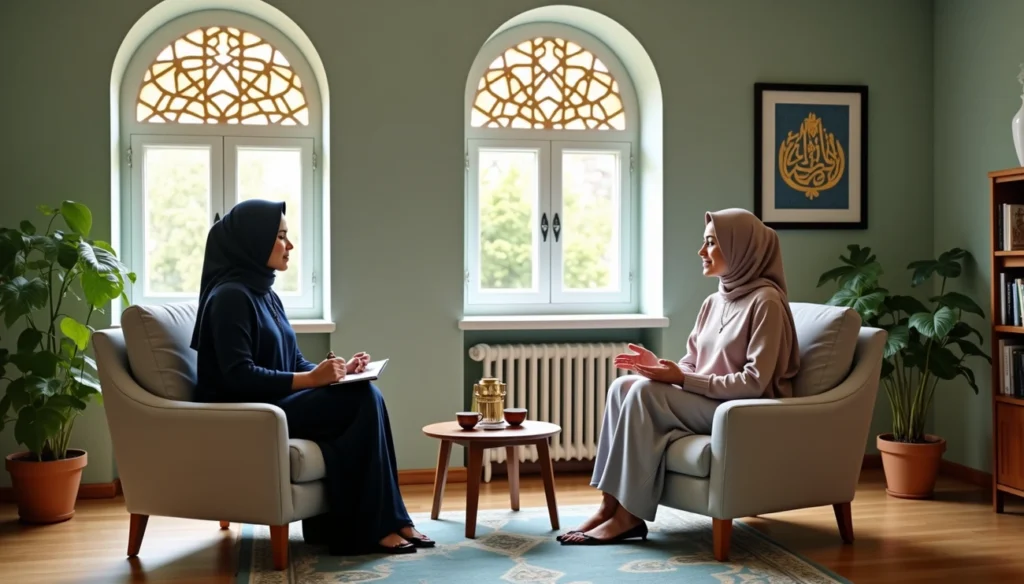
Modern psychology and Islamic traditions are finding common ground as mental health professionals develop integrative approaches that honor both scientific methods and spiritual values. The bridge between these two worlds offers Muslim patients healing pathways that align with their faith while incorporating evidence-based treatments.
Cognitive restructuring with Islamic principles
Cognitive restructuring in Islamic therapy modifies traditional CBT by integrating Quranic verses and Prophetic traditions to challenge negative thoughts. For instance, therapists use Al-Ghazali’s model of the human psyche, which identifies four interconnected elements: the “aql” (intellect), “qalb” (heart), “nafs” (self), and “ruh” (spirit). Unlike secular CBT, which prioritizes cognition, Islamic approaches emphasize the central role of the “qalb” (heart) in maintaining psychological equilibrium. The ABCD-R-E model exemplifies this integration by adding religious beliefs to traditional cognitive restructuring techniques. For many Muslims, learning how to find a culturally competent therapist can make the difference between abandoning care and receiving support that respects both faith and psychology.
Islamic counseling vs. Western psychotherapy
Islamic counseling differs fundamentally from Western approaches. Whereas Western therapy often focuses on individual achievement and self-actualization, Islamic counseling promotes righteousness and community welfare. Western therapy primarily addresses psychological symptoms through secular means, while Islamic counseling treats both spiritual and mental dimensions as inseparable. Moreover, Islamic counseling incorporates worship practices like salah (prayer) and dhikr (remembrance) as therapeutic interventions rather than merely respecting them as cultural factors. When combined with spiritual practices, evidence-based mental health interventions can enhance treatment outcomes by addressing both cognitive patterns and emotional resilience.
Addressing depression and anxiety in Islamic therapy
Research demonstrates the effectiveness of Islamic interventions for treating depression and anxiety. One study revealed that purposefully designed Islamic-based interventions significantly reduced anxiety levels in women and depression in men compared to control groups. Islamic therapy addresses cognitive errors through Quranic verses that counter hopelessness with divine mercy. For example, therapists might challenge depressive thoughts using the verse: “Know that victory comes through patience, and ease comes through hardship”.
Culturally competent care for Muslim patients
Providing culturally competent care requires understanding Islamic values regarding modesty, gender interactions, and religious obligations. Mental health professionals should recognize that Muslims may interpret symptoms as spiritual tests rather than medical conditions. During Ramadan, providers should adjust medication schedules to accommodate fasting. Additionally, clinicians should engage with local Muslim communities and faith leaders to reduce stigma and increase accessibility of mental health services. Understanding concepts like “jinn possession,” which may mirror symptoms of postpartum depression in Western terminology, helps therapists build stronger therapeutic alliances.
Overcoming Barriers to Mental Health Support
Despite Islam’s supportive stance on seeking treatment, barriers to mental health care persist across Muslim communities. Understanding these obstacles offers a pathway to more effective support systems.
Stigma and shame in seeking help
Barriers to mental healthcare often stem from religious misinterpretations. Many Muslims incorrectly view mental health difficulties as evidence of “weakness of faith” or punishment from Allah. This stigma extends beyond individuals to entire families, as mental illness in one member can negatively impact the family’s reputation. Studies reveal that 75% of Ethiopian families experienced stigma due to a relative with mental illness. Among immigrant Muslim women who experienced abuse, approximately 70% reported shame and 62% felt embarrassment when seeking mental health services.
Gender and cultural sensitivities in therapy
Gender dynamics significantly impact access to care. Women often face restrictions attending treatment alone or with male therapists. Meanwhile, men typically avoid seeking help due to cultural expectations regarding masculine roles. Cultural sensitivity remains crucial—patients from Saudi Arabia and Emirates prefer discussing personal matters generally without specific details. Additionally, language barriers and lack of translated information about available services prevent many from accessing appropriate care.
The importance of religiously informed therapists
Several studies indicate Muslim patients prefer therapists who share their faith. In communities where Muslims are minorities, clients believe Muslim therapists better understand their attitudes toward mental health challenges. Mental health professionals should possess Islamic literacy—familiarity with concepts like tawakkul, sabr, tawbah, and shukr—ensuring clients speaking in spiritual language aren’t pathologized.
Conclusion
The rich legacy of Islamic approaches to mental health offers Muslims a uniquely holistic framework for healing. Through the centuries, Muslim scholars have recognized the deep connection between spiritual and psychological wellbeing, establishing pioneering mental health facilities and developing sophisticated understandings of emotional disorders. Therefore, modern Muslims need not feel conflict between their faith and seeking professional mental health support.
Faith-based practices such as tazkiyah, muraqabah, and dhikr undoubtedly serve as powerful tools for maintaining psychological balance. However, these spiritual approaches work best alongside—rather than instead of—evidence-based therapeutic interventions. This integrated approach acknowledges both the biological aspects of mental health conditions and the spiritual dimensions central to Muslim identity.
Stigma remains a significant obstacle for many Muslims considering mental health support. Nevertheless, awareness is growing as more culturally competent practitioners emerge who understand Islamic principles and values. Muslims who seek therapists familiar with their faith often report better outcomes and stronger therapeutic relationships.
Although barriers persist, particularly around gender sensitivities and cultural expectations, the future looks promising. The integration of Islamic wisdom with contemporary psychological knowledge creates a comprehensive approach to healing that honors both tradition and science. Mental health, after all, represents not merely the absence of illness but the presence of spiritual, emotional, and social wellbeing—a holistic concept entirely consistent with Islamic teachings.
Finally, we must remember that seeking help demonstrates strength rather than weakness. The Prophet Muhammad himself emphasized both divine reliance and practical action when he advised: “Trust in Allah, but tie your camel.” Similarly, today’s Muslims can embrace both spiritual practices and professional support as complementary paths toward the same destination—inner peace and balanced wellbeing. Faith-centered practices combined with therapeutic tools support finding inner peace and emotional balance, reinforcing Islam’s holistic approach to mental wellbeing.
FAQs
How does Islam view mental health issues?
Islam recognizes the importance of mental health and encourages seeking help for psychological issues. The Islamic tradition emphasizes the interconnectedness of physical, mental, and spiritual well-being, viewing mental health as an integral part of overall health.
What are some Islamic practices that can help improve mental health?
Several Islamic practices can contribute to better mental health, including tazkiyah (purification of the soul), muraqabah (Islamic mindfulness), dhikr (remembrance of Allah), and Islamic meditation. These practices help in cultivating virtues, reducing stress, and fostering a sense of inner peace.
Can Muslims seek professional mental health treatment?
Yes, Muslims can and should seek professional mental health treatment when needed. Islam encourages seeking knowledge and help in all matters, including health. Many Muslim scholars and mental health professionals advocate for integrating Islamic principles with modern therapeutic approaches.
How can mental health professionals provide culturally competent care to Muslim patients?
To provide culturally competent care, mental health professionals should understand Islamic values, respect modesty and gender interactions, recognize religious obligations, and be familiar with Islamic concepts related to mental health. It’s also helpful to engage with local Muslim communities and faith leaders to build trust and reduce stigma.
What are some common barriers Muslims face in seeking mental health support?
Common barriers include stigma and shame associated with mental health issues, misinterpretation of religious teachings, cultural expectations, gender-related restrictions, language barriers, and a lack of culturally competent mental health providers. Overcoming these barriers often requires education, community outreach, and increased availability of Muslim mental health professionals.